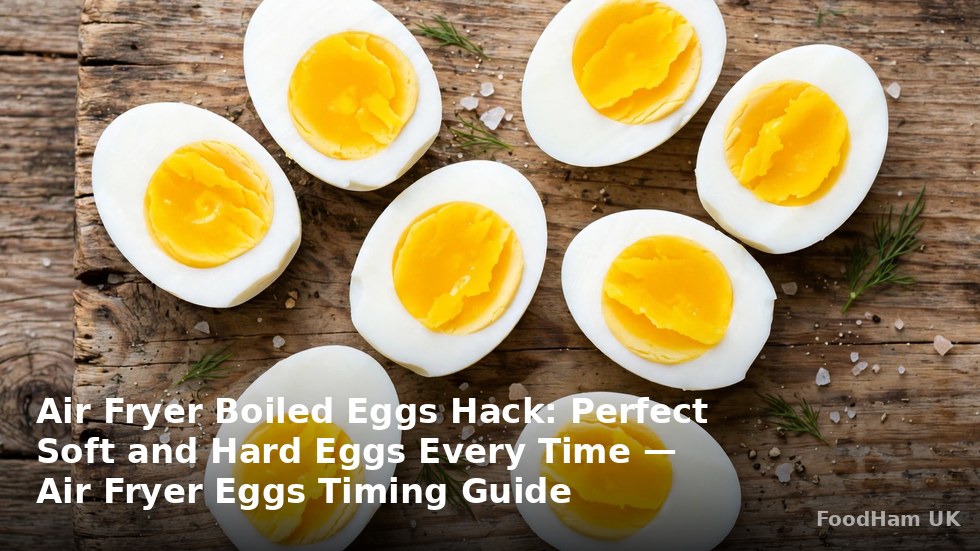
Air Fryer Boiled Eggs Hack: Perfect Soft and Hard Eggs Every Time — Air Fryer Eggs Timing Guide
There is a particular kind of kitchen faff that involves standing over a pan of boiling water, squinting at the clock, and still ending up with a yolk that’s either chalky or alarmingly raw. The air fryer version of this job — this air fryer eggs timing guide — removes all of it. No water to boil, no pan to scrub, no guesswork about when to start the timer. You put cold eggs in a basket, set a temperature, set a time, and go and do something else.
It sounds like a gimmick until you try it. The circulating hot air cooks an egg in its shell remarkably evenly, and because the temperature is controlled by a dial rather than the mood of your hob, the results are repeatable. Once you know your machine’s timings, you can produce the exact same soft-boiled egg every single morning. For a budget kitchen, there’s another win: you’re running a small appliance for ten minutes instead of heating a full hob ring and a pan of water, and the cost per egg stays at whatever the supermarket charges — around 15p each from a value pack.
Air Fryer Eggs Timing Guide: The Method in Plain English
The core idea is simple. An egg in its shell goes into the air fryer basket in a single layer, the machine runs at 150°C, and the only variable that matters is time. There is no preheating worth mentioning, no water, no oil, no foil. The shell is a self-contained cooking vessel, and the hot air does the rest.
What surprises most people is how forgiving the method is once you learn your timings. With a pan, the difference between a jammy yolk and a set one can be thirty seconds of distraction. In the air fryer, the same difference is about two minutes, because the heat transfer is gentler and more even. That wider margin for error is exactly why this method suits busy mornings — you can afford to be a minute late without ruining breakfast.
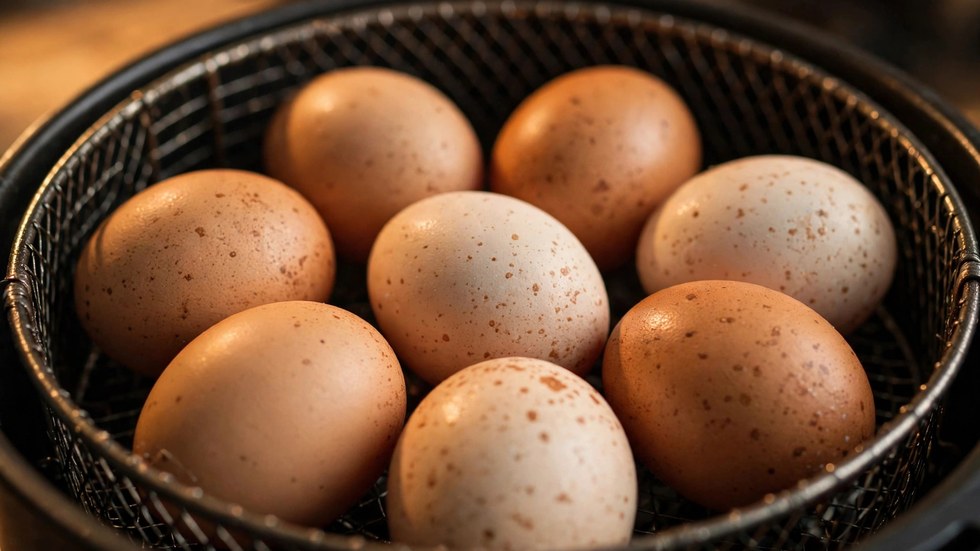
There is one thing to understand before you start: every air fryer runs slightly differently. A compact 3.5-litre drawer model will cook a touch faster than a big dual-basket machine, and a machine that’s already warm from cooking something else will cook faster than a cold one. The timings below are honest starting points based on medium-to-large eggs taken straight from the fridge. Treat your first batch as a calibration run: cook two eggs, check them, and adjust by a minute either way. After that, you’re set for life.
Do You Preheat the Air Fryer for Eggs?
Short answer: no. Longer answer: it doesn’t hurt, but it doesn’t help either, because the eggs need a minute or two of gentle warming as the basket comes up to temperature, and that gentle start actually improves the texture. Starting from cold gives the white time to set gradually rather than seizing, which means fewer cracked shells and a more even cook.
If your air fryer forces a preheat cycle and won’t let you skip it, don’t fight it — just drop your timings by about a minute, since the eggs will hit full heat sooner. Either way, write down what worked on a sticky note and keep it on the fridge. This is the kind of kitchen knowledge that only needs learning once.
The Timing Chart That Ends the Guesswork
All timings below assume medium-to-large eggs straight from the fridge, cooked at 150°C in a single layer with space between them. If your eggs are room temperature — say you keep them in a cupboard — take about a minute off each time. If they’re small eggs, take a minute off; very large ones, add a minute.
| Finish | Time at 150°C | What you get | Best for |
|---|---|---|---|
| Runny soft-boiled | 7 minutes | Barely-set white, fully liquid yolk | Soldiers and toast, dipping |
| Classic soft-boiled | 8 minutes | Set white, runny golden yolk | Ramen, salads, brunch |
| Jammy | 9–10 minutes | Firm white, thick spoonable yolk | Grain bowls, avocado toast |
| Medium | 11 minutes | Mostly set yolk, slightly soft centre | Packed lunches, picnics |
| Hard-boiled | 12–13 minutes | Fully set yolk, still creamy | Meal prep, snacks |
| Very firm | 14–15 minutes | Fully set, paler yolk | Devilled eggs, scotch eggs |
Notice the gap between jammy and hard is only a few minutes — that’s the whole game with eggs. If you’re cooking for a household that wants different finishes, cook the full batch to the softest finish anyone wants, pull those eggs out, and put the rest back in for a few more minutes. It’s easier than juggling two pans, and everyone gets exactly what they asked for.
One more calibration tip: if your 8-minute egg comes out closer to jammy than runny, your machine runs hot. Drop everything by a minute and retest. If it comes out underdone, add a minute. Two test eggs is a 30p investment in never thinking about this again.
UK Air Fryer & £1 Meal Prep Cost Estimator
Enter your costs in £ GBP and see per-portion cost, macros and air fryer energy savings.
Step by Step: Fridge to Ice Bath in 20 Minutes
Here’s the full routine for a batch of six eggs, which is the sweet spot for most air fryer baskets — enough for several days of breakfasts without crowding the basket. Crowding is the enemy: eggs need hot air circulating around each one, so a single layer with small gaps is essential. If your basket is small, cook in two batches rather than stacking.
- Arrange the eggs. Take 6 medium-to-large eggs straight from the fridge and place them in the air fryer basket in a single layer. They don’t need to be oiled, pricked or wrapped in anything. If they roll around, that’s fine — they won’t go anywhere once the fan starts.
- Set 150°C and your chosen time. Dial in 150°C and the time from the chart above for the finish you want. For a first calibration batch, try 8 minutes for classic soft-boiled or 12 minutes for hard-boiled. Start the machine.
- Prepare the ice bath while they cook. Fill a large bowl with cold water and a tray’s worth of ice cubes — or, if you’re out of ice, the coldest water your tap produces plus a handful of frozen peas from the freezer. This step matters more than people expect, so don’t skip it.
- Transfer immediately. The moment the timer goes off, use tongs or a spoon to move the eggs straight into the ice bath. Don’t leave them sitting in the hot basket “for a minute” — residual heat keeps cooking the yolk, and a minute of carryover is the difference between jammy and set.
- Cool for at least 5 minutes. Leave the eggs in the ice bath for a full 5 minutes, topping up with cold water if it warms up. This stops the cooking dead and — just as importantly — makes the shell release from the white far more easily.
- Peel or store. Peel soft eggs right away for eating. For hard-boiled eggs you’re keeping, you can store them unpeeled in the fridge and peel as needed — the shell protects them and they peel just as easily after a day or two.
- Eat or refrigerate promptly. Peeled eggs should be eaten or refrigerated straight away. Keep unpeeled hard-boiled eggs in the fridge and eat within 3 days for best quality.
The Peeling Trick That Actually Works
Fresh eggs are notoriously hard to peel, and no internet hack fully defeats physics — but the combination of the ice bath and this technique gets you as close as it gets. The goal is to get water under the shell membrane, which is what actually sticks.
- Crack all over, not just in one spot. Tap the cooled egg firmly on the worktop and roll it gently under your palm so the shell is crazed with fine cracks all over, like a mosaic.
- Start at the wide end. There’s an air pocket at the blunt end of every egg. Break the shell there first and peel back a coin-sized patch of shell plus the papery membrane underneath it.
- Peel under running cold water. Hold the egg under a thin stream of cold water as you peel. The water slides under the membrane and the shell comes off in big satisfying sheets instead of tiny frustrating shards.
- For stubborn eggs, peel in the bowl. Drop the cracked egg back into the ice bath for a minute, then peel it while it’s submerged. The water does the work for you.
- Older eggs peel more easily. If you’re batch cooking for the week, use the eggs that have been in the fridge longest. Save the just-bought ones for frying, where peeling doesn’t matter.
Cost and Energy: The Honest Maths
Eggs remain one of the cheapest sources of protein in a British supermarket, and the air fryer method doesn’t add any meaningful cost to them. A 15-pack of value eggs typically costs around £2.20, which works out at roughly 15p per egg. Cook six for breakfast prep and you’ve spent about 90p — less than a third of the price of a single café-bought boiled egg, if such a thing existed, and far less than any takeaway breakfast.
On energy, the honest position is this: running a typical air fryer for 10–12 minutes uses a modest amount of electricity — as a rough estimate, a few pence per cycle at current tariffs, though the exact figure depends on your model and your tariff. That’s meaningfully less than heating a full-size oven for the same job, and it avoids the classic hob-egg waste of boiling a pan of water you then pour down the sink. The savings per batch are small, but if eggs are a daily habit, they add up across a year — and the convenience saving is the real prize.
| Batch of 6 eggs | Time | Est. cost |
|---|---|---|
| Ingredients (6 value eggs) | — | ~£0.90 |
| Air fryer, 12 min at 150°C | 12 minutes | A few pence (estimate) |
| Ice bath (tap water + ice) | 5 minutes cooling | Negligible |
| Total per egg | ~17 minutes | ~15–16p |
Compare that with buying ready-boiled eggs or egg-based snacks from a shop, where you can easily pay 50p to £1 per egg once packaging and markup are involved. The air fryer batch is a fraction of the price and you control the timing exactly.
Storing Cooked Eggs Safely
Batch cooking only works if the storage is right. Unpeeled hard-boiled eggs keep well in the fridge — the shell is nature’s own packaging — and they’re fine for up to 3 days, which covers a long weekend of breakfasts and packed lunches. Keep them in a covered container or a clean egg box so they don’t pick up fridge odours.
- Unpeeled in the fridge: up to 3 days, stored in a covered container.
- Peeled in the fridge: keep submerged in a bowl of cold water with a lid, change the water daily, eat within 2 days.
- Soft-boiled with runny yolks: eat straight away — they’re not candidates for storage.
- Never freeze boiled eggs: the whites turn rubbery and watery on defrosting. Freeze raw beaten egg instead if you need to preserve eggs.
- Label your batches: if you cook soft and hard in the same session, mark the hard ones with a pencil cross on the shell so nobody cracks a runny egg into their lunchbox.
What If an Egg Cracks in the Basket?
It happens occasionally — usually with very fresh eggs or if the machine runs hot. A small crack normally seals itself as the white sets, and the egg is perfectly fine to eat. If an egg cracks badly and white leaks everywhere, it’s still safe to eat as long as it cooked through, but give the basket a wash before the next batch. To minimise cracks, avoid the very highest temperatures — 150°C is the sweet spot — and don’t cook eggs that already have hairline cracks in the shell.
Five Ways to Use a Batch of Air Fryer Eggs
Six perfect hard-boiled eggs are a meal-prep building block. They turn a plain salad into lunch, a bowl of instant noodles into dinner, and a slice of toast into something you’d actually look forward to.
- Ramen upgrade: halve a jammy 9-minute egg over instant noodles with a splash of soy sauce. It tastes like a £12 restaurant bowl for about 40p.
- The 2-minute egg salad: chop two hard-boiled eggs, mix with a spoonful of mayo, mustard and chopped spring onion. Fills two sandwiches.
- Buddha bowl topper: jammy eggs over rice, frozen edamame and whatever veg needs using up, with a drizzle of chilli oil.
- Scotch egg shortcut: wrap a 12-minute egg in seasoned sausage meat, brush with beaten egg, roll in breadcrumbs and air fry at 180°C for 12–15 minutes.
- Curried eggs: warm leftover curry sauce and drop in halved hard-boiled eggs for the last 5 minutes. A classic budget dinner that costs pennies.
Final Thoughts
The air fryer egg hack earns its place in a budget kitchen not because it’s flashy but because it’s reliable. Once your timings are calibrated, there’s no more hovering over a pan, no more fishing eggs out of boiling water with a spoon, and no more breakfast roulette. Just a basket, a dial, an ice bath, and the same perfect egg every time — for about 15p. If your air fryer has been sitting on the counter mostly making chips, this is the week to teach it a new trick.
You May Also Like
Air Fryer Turkey Burger Recipe: Low-Fat High-Protein Lunch Bowls
Air Fryer Breakfast Meal Prep: How to Batch Cook Sausages and Bacon for the Freezer