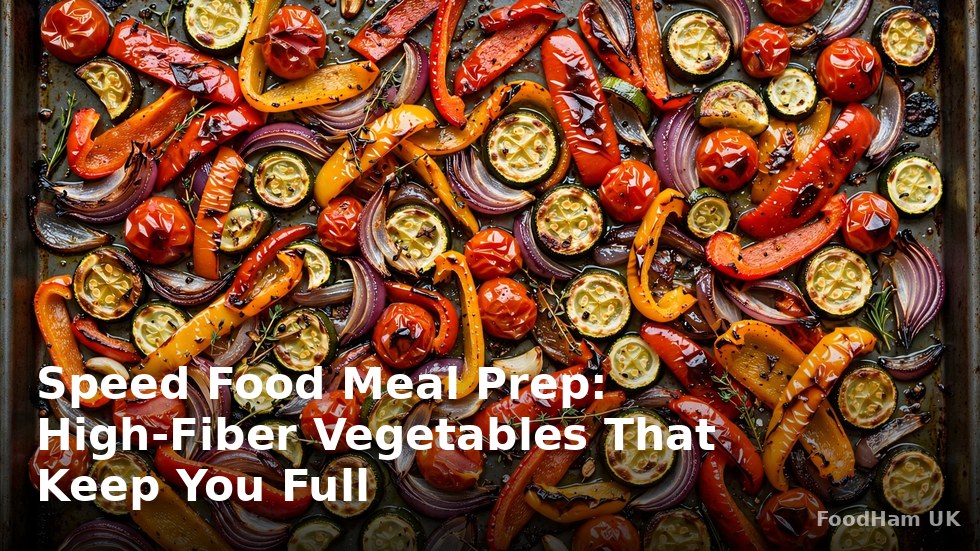
Speed Food Meal Prep: High-Fiber Vegetables That Keep You Full
There’s a particular kind of hunger that ruins good intentions — the hollow, gnawing kind that arrives at 3pm and sends you to the vending machine. The usual advice is willpower. The better advice is fibre. High-fibre vegetables add physical bulk to your meals for almost no calories, and that bulk is what tells your stomach it’s had enough. This is the entire logic behind speed food meal prep ideas: batch-cook the vegetables that keep you fullest, and build every lunch and dinner of the week around them.
“Speed food” is a term from the slimming-plan world for foods that are low in calories but high in volume — the vegetables you’re encouraged to fill half your plate with. I use it here as informal, homemade shorthand, not as an official category. This site is not affiliated with, sponsored by, or endorsed by Slimming World. What follows is practical, budget-first meal prep built on the unglamorous truth that a tray of roasted peppers, courgettes and onions — costing about 40p a portion — is one of the most effective hunger-management tools in a home kitchen.
The plan below takes about 90 minutes on a Sunday and produces enough prepped veg for 10–12 meals. Everything is built from cheap, sturdy vegetables that reheat well, because delicate leaves and watery veg are meal-prep liabilities.
Why Fibre Keeps You Full (the Short Version)
No miracle claims here — just mechanics. Fibre adds bulk that physically stretches the stomach, which is one of the signals your body uses to register fullness. It also slows down digestion, so the energy from your meal releases gradually instead of spiking and crashing. A bowl of soup made from 300g of blended vegetables carries maybe 120 calories but occupies the same stomach space as a far more calorific meal — and most people find they stay satisfied for two to three hours on it.

The UK recommendation is 30g of fibre a day; most adults manage about half that. Each of the preps below delivers 8–12g of fibre per portion, which means two of them a day gets you most of the way there without thinking about it. That’s the quiet advantage of speed food meal prep ideas: the nutrition takes care of itself while you’re just eating tasty food.
Speed Food Meal Prep Ideas: The 90-Minute Sunday Session
Set a timer and work in this order — the oven does most of the work while you chop the next batch. You’ll need your largest roasting trays, a big soup pot, and a stack of containers.
Prep 1: The Mega Roast Trays (makes 8 portions)
This is the backbone of the week. Roasted vegetables caramelise, concentrate in flavour, and reheat far better than steamed or boiled veg.
- 3 peppers (any colour — buy the value 3-pack), cut into chunks
- 3 courgettes, cut into thick half-moons
- 3 red onions, cut into wedges
- 500g cherry tomatoes, halved
- 1 whole head of garlic, cloves separated but unpeeled
- 2 tbsp olive oil, 1 tbsp balsamic vinegar
- 1 tbsp mixed herbs, salt and pepper
Toss everything across two large trays — don’t crowd them or the veg steams instead of roasting. Roast at 200°C (fan 180°C) for 35–40 minutes, turning once, until the edges char and the tomatoes collapse into jammy puddles. Squeeze the roasted garlic from its skins and mash it through. Divide into containers: roughly 200g per portion, about 110 calories and 4g fibre each.
Prep 2: Freezer Soup Bags (makes 6 portions)
Soup is the highest-volume, lowest-calorie meal in existence, and bagged soup portions are the ultimate lazy dinner.
- 1kg frozen mixed veg (the 99p kilo bags — carrots, peas, sweetcorn, green beans)
- 2 onions, diced
- 4 carrots, chopped
- 2 sticks celery, chopped
- 2 vegetable stock cubes
- 1 tsp smoked paprika, 1 tsp cumin
- 400g tin chopped tomatoes
Soften the onion, carrot and celery in a sprayed pot for 8 minutes. Add the spices, tomatoes, frozen veg and 1.5 litres of water with the stock cubes. Simmer 25 minutes. Blend half the pot and leave half chunky — the mix of smooth and textured eats far more satisfyingly than either alone. Cool and bag in 400ml portions. Each portion: roughly 130 calories, 7g fibre. Freeze flat in bags — they stack like books and defrost in minutes under the tap.
Prep 3: Stir-Fry Kits (makes 4 portions)
Pre-chopped stir-fry veg from the supermarket costs £2+ a bag. Chop your own in ten minutes for a third of the price.
- 1 white cabbage (about 800g), finely shredded
- 4 carrots, cut into matchsticks
- 200g frozen edamame or peas
- 1 bunch spring onions, sliced
- Thumb of ginger, grated, and 3 garlic cloves, crushed — mixed into a paste
Bag the shredded veg in portions with a teaspoon of the ginger-garlic paste in each bag. They keep 4 days in the fridge. To cook: screaming-hot wok, teaspoon of oil, 3–4 minutes, then soy sauce and a splash of water. Cabbage is the unsung hero here — 25 calories per 100g, 3g fibre, and it stir-fries in minutes while costing about 70p a kilo.
Prep 4: Grain-Bowl Roast Veg (makes 4 portions)
Heartier veg that turn a grain bowl into a proper meal:
- 1 butternut squash, cubed (or a 500g bag of pre-cut — worth it for the time saved)
- 500g sweet potatoes, cubed
- 2 red onions, wedged
- 400g tin chickpeas, drained and patted dry
- 2 tbsp olive oil, 2 tsp smoked paprika, 1 tsp cumin
Roast at 200°C for 30–35 minutes until the edges crisp — the chickpeas go properly crunchy and nutty. Each portion: roughly 280 calories, 9g fibre. Pair with 60g (dry weight) bulgur wheat or couscous and a dollop of yoghurt for a complete lunch around 450 calories that keeps you full until dinner.
UK Air Fryer & £1 Meal Prep Cost Estimator
Enter your costs in £ GBP and see per-portion cost, macros and air fryer energy savings.
The Week at a Glance: How It All Fits Together
| Day | Lunch | Dinner base |
|---|---|---|
| Monday | Mega roast veg + 2 boiled eggs + pitta | Soup bag + crusty roll |
| Tuesday | Grain-bowl veg + bulgur + yoghurt | Stir-fry kit + chicken strips |
| Wednesday | Soup bag + cheese toastie | Mega roast veg + pasta + parmesan |
| Thursday | Stir-fry kit + prawns + noodles | Grain-bowl veg + fried egg + chilli sauce |
| Friday | Mega roast veg + tuna + baked potato | Soup bag + garlic bread |
Notice the pattern: the prepped veg is the constant, and a small amount of protein or carbs turns it into a complete meal. You’re never cooking veg from scratch on a weeknight — just reheating and adding the fresh bit. That’s what makes the habit sustainable: the friction is near zero.
Cost Breakdown: 40p Veg Portions
| Prep | Total batch cost (est.) | Portions | Per portion |
|---|---|---|---|
| Mega roast trays | £3.60 | 8 | £0.45 |
| Freezer soup bags | £2.80 | 6 | £0.47 |
| Stir-fry kits | £2.20 | 4 | £0.55 |
| Grain-bowl roast veg | £3.40 | 4 | £0.85 |
| Total Sunday shop | £12.00 | 22 | £0.55 avg |
£12 of vegetables becomes 22 meal components — add your proteins and carbs through the week and you’re looking at complete lunches and dinners for £1.50–£2 each. The frozen veg does serious work in the soup; don’t be a snob about it. Nutritionally it’s picked and frozen within hours, and at 99p a kilo it’s the best value in the supermarket.
Vegetables That Meal-Prep Well (and Ones That Don’t)
Not all veg survives the week. The winners are sturdy, low-water vegetables: peppers, courgettes, onions, carrots, cabbage, butternut squash, sweet potato, broccoli (roasted, not steamed), cauliflower and mushrooms (roasted hard). They reheat with their texture mostly intact.
The losers: cucumber (goes limp), lettuce (wilts within a day), fresh spinach (fine wilted into hot dishes, terrible reheated on its own), bean sprouts (one day max), and courgette spaghetti (weeps water everywhere). Add these fresh at serving time instead of prepping them — a handful of fresh leaves on top of reheated roast veg takes ten seconds and transforms the bowl.
Keeping It Interesting: The Flavour Rotation
The risk with any meal prep is flavour fatigue by Thursday. The fix isn’t more recipes — it’s finishing flavours, added fresh at serving time:
- Acids: lemon juice, lime wedges, vinegar-based hot sauce — brightness cuts through roasted richness
- Crunch: toasted seeds, crushed peanuts, crispy onions — texture contrast makes reheated food feel fresh
- Creamy: a spoonful of yoghurt, hummus or tahini drizzle — richness without much calorie cost
- Fresh herbs: coriander, parsley, basil — ten seconds of chopping, completely different meal
- Spice pivots: the same roast veg goes Mediterranean with oregano and feta, Indian with curry powder and yoghurt, or Mexican with cumin, lime and coriander
Rotate two or three of these per meal and the same Sunday veg tastes different every day. This is the difference between meal prep you abandon in February and meal prep that quietly runs your kitchen all year.
Storage Rules That Actually Matter
- Cool fast: spread hot veg on trays for 15 minutes before boxing — boxing steaming veg creates condensation and sogginess.
- Fridge life: roasted veg 4 days, soup 4 days (or 3 months frozen), stir-fry kits 4 days raw.
- Reheat once: microwave portions with a sprinkle of water; the oven (180°C, 10 minutes) gives better texture for roast veg if you have time.
- Label everything: frozen soup bags all look identical — date and contents on every bag, or you’ll be defrosting mysteries.

You May Also Like
High-Protein Slimming World Friendly Beef & Broccoli Stir-Fry

High-Protein Greek Yogurt Garlic Dip for Low-Calorie Dipping